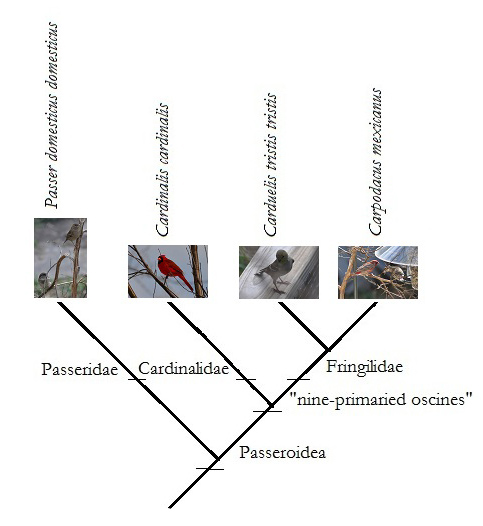
At the beginning of the semester, I was pleasantly surprised to learn that many of my readers like birding as much as I do. In fact, I got a pretty positive response from my "virtual birding" posts and the phylogenetic format they followed. So I figured why not give the people what they want, right? Let's expand that cladogram a little to accommodate my two new backyard birds from Saturday's post.

Showing posts with label cladistics. Show all posts
Showing posts with label cladistics. Show all posts
Monday, May 14, 2012


Monday, January 30, 2012
Virtual Birding Roundup (Part 3)
 Alright, boys and girls. I started this little endeavor a month ago. It's time to bring it all together, once and for all. So far in our virtual birding roundup, we've spent the last two parts talking about various families within the order Passeriformes. Which makes sense considering that there are over 100 different passerine families, and they contain more than half of all known bird species (Mayr, 1946). For the most part, the relationships between these families were traditionally defined by morphological characters, and were believed to be fairly well understood. But recently, more and more molecular analysis has begun to show a different phylogeny; one that we still don't have a full picture of. And that's where the next bird from our quiz comes in.
 |
| Regulus calendula |
Wednesday, January 25, 2012
Virtual Birding Roundup (Part 2)
Friday, January 06, 2012
Virtual Birding Roundup (Part 1)
Time to talk birds, specifically the ones I posted photos of in my "end of year bird quiz" . To spice things up a bit, instead of just listing as each species and writing about it a little, I'm going to throw them all onto an ever expanding cladogram. Hopefully this way both the readers and myself will be able to learn a little about the individual animals themselves, and their relationships to one another. Ornithology is certainly not an area of specialization for me. But birding is one of the "outdoor" activities I engage in most often. This is primarily because it can be done anywhere, even the comfort of your own home. So I think this will be a fun little project and I'm excited to be able to share it with you all. But a word of warning: apparently a lot of the traditional bird groupings are not supported by molecular data, and many of their true relationships have yet to be resolved. So I'll be doing my best to show true monophyletic groupings and relationships. But if you know something I don't, please let me know. That being said, let's dig right in and start with the birds from my quiz! Read no further if you'd like to give it a shot before I start naming names.
Wednesday, August 11, 2010
"Guess the Squamate" Roundup
A month and some change back I posted some of my photos from the "Lizards & Snakes: ALIVE!" exhibition at the American Museum of Natural History and asked you all to to do a little homework. Well, fellow blogger Susan stepped up to the challenge and successfully named each one of the squamates I photographed. As promised, now it's time to briefly talk a little about each of them and their relationships with one another. I'll also be including a ton of Wikipedia links so that those who want to find out more about the species or clade I'm talking about can easily do so (I normally take Wikipedia with a grain of salt, but to be fair, they are starting to cite a lot of references so check those out too).

The first squamate pictured was the serpent Corallus caninus, commonly known as the emerald tree boa. This boid is a arboreal native of the rain forests of South America, and as you can see, is a pretty good looking animal. This specimen in particular is seen in a typical Corallus pose, coiled around the branch of a tree, head in center. It will remain like this for most of the daylight hours, as it is a nocturnal hunter. Staying coiled up as it hunts, it extends the head and neck out, waiting patiently for a small mammal, bird, or frog to pass by before it strikes with atypically large teeth for a non-venomous snake. It then pulls it's prey in, and like other boas, constricts it until it suffocates. And for those who already think snakes are creepy enough, here's a fun fact for you: Corallus is ovoviviparous, meaning that the mother never lays eggs, but rather, retains them inside of her body as the young develop and hatch, until she finally gives birth to live young (Mehrtens 1987). Awesome.
Thursday, May 27, 2010
(New) soft bodied cephalopods from the Cambrian.
Is it Cephalopodmas already?!?! No, but it sure feels like it. Today the journal Nature published an article describing a previously known species, Nectocaris pteryx, in an entirely new light. In their new paper, Martin R. Smith and Jean-Bernard Caron reinterpret Nectocaris based on the holotype and 91 additional (brand spanking new) specimens that help show where this peculiar Middle Cambrian critter belongs on the "Tree of Life".
 Restoration of Nectocaris based on old evidence, by Ghedoghedo, from Wikimedia Commons.
 Restoration of Nectocaris based on old evidence, by Ghedoghedo, from Wikimedia Commons.
Thursday, May 13, 2010
Universal Common Ancestry : I got it.
Yay science! Great news from the journal Nature this week. Douglas Theobald from Brandeis University (who writes for TalkOrigins from time to time) has published a paper that, for the first time, tests the theory of universal common ancestry. This a central part of the theory of descent with modification via natural selection (or evolution, for short), and while most scientists had accepted the notion that all known living organisms share a common ancestor at the base of the tree of life, no one had actually gone about formally testing the idea.

Tuesday, April 13, 2010
"Tree of Lies"
Yes, I too thought it was a clever play on words. I am, from time to time, extremely vocabularious (a term coined by my brother and I back at the turn of the 21st century that means "funny with words" but apparently has other current definitions on the internet).
This is just a teaser post/question for my readers. Can anyone spot the problems with this cladogram? I'll give you a hint: it is not accurate. If you've already been part of the e-mail discussion regarding it, don't spoil it for everyone else, at least not immediately. Everyone else, happy hunting!
This is just a teaser post/question for my readers. Can anyone spot the problems with this cladogram? I'll give you a hint: it is not accurate. If you've already been part of the e-mail discussion regarding it, don't spoil it for everyone else, at least not immediately. Everyone else, happy hunting!


Monday, February 01, 2010
Ardipithecus ramifications. (Science in the media part II)

Back in October, I wrote the first post in a series on science, education, and the media. Needless to say, I never got around to finishing that series, or answering the initial question of my friend regarding my thoughts on the (then) recent publication of papers and news articles on Ardipithecus ramidus, and the interpretation of the fossils by the scientist who claims that "apes descended from humans".
Thursday, January 28, 2010
Gotta clade 'em all!
My friend Peter has started his own blog (The Nameless Blog) about video games, and has published more posts in his first week than I did in my first month. If you're a gamer I highly recommend you check it out. But his writing has inspired me to write about one of my gaming experiences that, surprisingly, I can tie into the science/nature/education content I like to write about here at Superoceras.
I'm not going to lie to any of you. Back in the fall of 1998, my interests in speculative biology, video games, and collecting things all merged together in what I considered to be the coolest trend of the day: Pokémon. I probably shouldn't admit it, but I spent a great deal of time capturing, training, and battling those little "pocket monsters". I even did a phylogeny of the first 151 creatures as a gag with a friend of mine. I wish I could find it. Don't lie, you want to see it too.
Thursday, November 26, 2009
Another helping of dinosaur, please!
That's right people, I said dinosaur. Over the last few decades, more and more evidence has been discovered that proves one very basic fact: birds are the direct descendants of theropod dinosaurs that survived the extinction event 65.5 million years ago.


Image courtesy of and credited to Dr. Thomas R. Holtz, Jr. (text labels) and http://www.ucmp.berkeley.edu/museum/events/bigdinos2005/turkey.html (skeletal drawing). Click to enlarge.
Monday, November 02, 2009
Understanding the "Tree of Life"
A friend of mine (who can take credit for these posts in the form of a response, should he like to be recognized) recently asked me a question regarding the newly discovered hominid Ardipithecus ramidus, and the scientist who claims that "apes descended from humans". This immediately set off a number of alarms in my head, not in response to his asking the question, but in response to what I think are two issues facing science and scientists today: the lack of proper scientific literacy and education in the United States, and the role and influence that the media has when presenting scientific information to the public. These are both topics that have been brought up recently on the vertebrate paleontology mailing list, and while I didn't chime in there, I figure this is as good a place as any to speak up. This will be the first post in a series that I hope will shed some light on these issues, and help reach those who have questions similar to those of my friend. So let's get right down to business.
Subscribe to:
Posts (Atom)